2008-03-11

Historic Forts and Batteries (基隆古砲台)

Its natural deep sea anchorage and proximity to Taipei made Keelung of vital strategic importance to Taiwan's rulers for nearly two centuries. Today, while a few hilltop military posts remain manned (with at least one topped by a prominent battery of antiaircraft missiles), most former strongholds have been abandoned to weekend hikers, gardeners, fast growing vegetation ... or some combination of all three.

Beyond the half dozen or so batteries designated as historic sites by the city, Keelung has at least as many which, a la Raiders of the Lost Ark, now lie buried beneath banyan trees and decades of growth. In addition to the formal batteries, dozens of lookouts and pillboxes are also scattered in several rings around the city - reminders that the entire Keelung area was designated a military zone「要塞」 by the Japanese during their 50-year rule on the island (1895-1945).

However, as with a good deal of Taiwan history, much in the way of details on northeast coast fortifications has been lost or buried away in dank files accessed only occasionally by the particularly diligent graduate student, ... leaving the visitor to make educated guesses about when structures were built and where they fit into island defense.

Today, these relics of the past are a definite enticement to visiting the Northeast Coast. Off the beaten path, even well-marked batteries rarely see more than a trickle of visitors. In a crowded place like Taiwan, their combination of solitude, great views (locations were chosen specifically for spying across the surrounding terrain) and enigmatic stone block structures are greatly appreciated!

Keelung Fortifications

After the Dutch abandoned Keelung for a second and final time in 1668, San Salvador - the earliest fort on Keelung Bay - sat crumbling and largely forgotten. China's supremacy in East Asia was still widely respected and its harbors were secure even without protective fortifications.


Expansion-minded Western traders undermined and ultimately demolished the Chinese peace, setting themselves up at prime anchorages around the region, playing local politics, and eventually delivering up entire slices of Asia to direct European rule (e.g., the Dutch in Batavia [1619], the British in Singapore [1819]; the Russians in Vladivostok [1860]; and the French in Saigon [1862]).


In response to this unprecedented threat from the sea, the Qing built two forts astride Keelung's inner harbor entrance. These quickly proved their worth by foiling at least three attempts by the British to shell the town during the First Opium War (1839-42).

The Qing later extended Keelung's fortifications and, by the early 1880s, some 10 artillery batteries fringed the bay. Most were set close to the water's edge to compensate for limited cannon range and, as a result, have since disappeared beneath container terminals and urban planning.

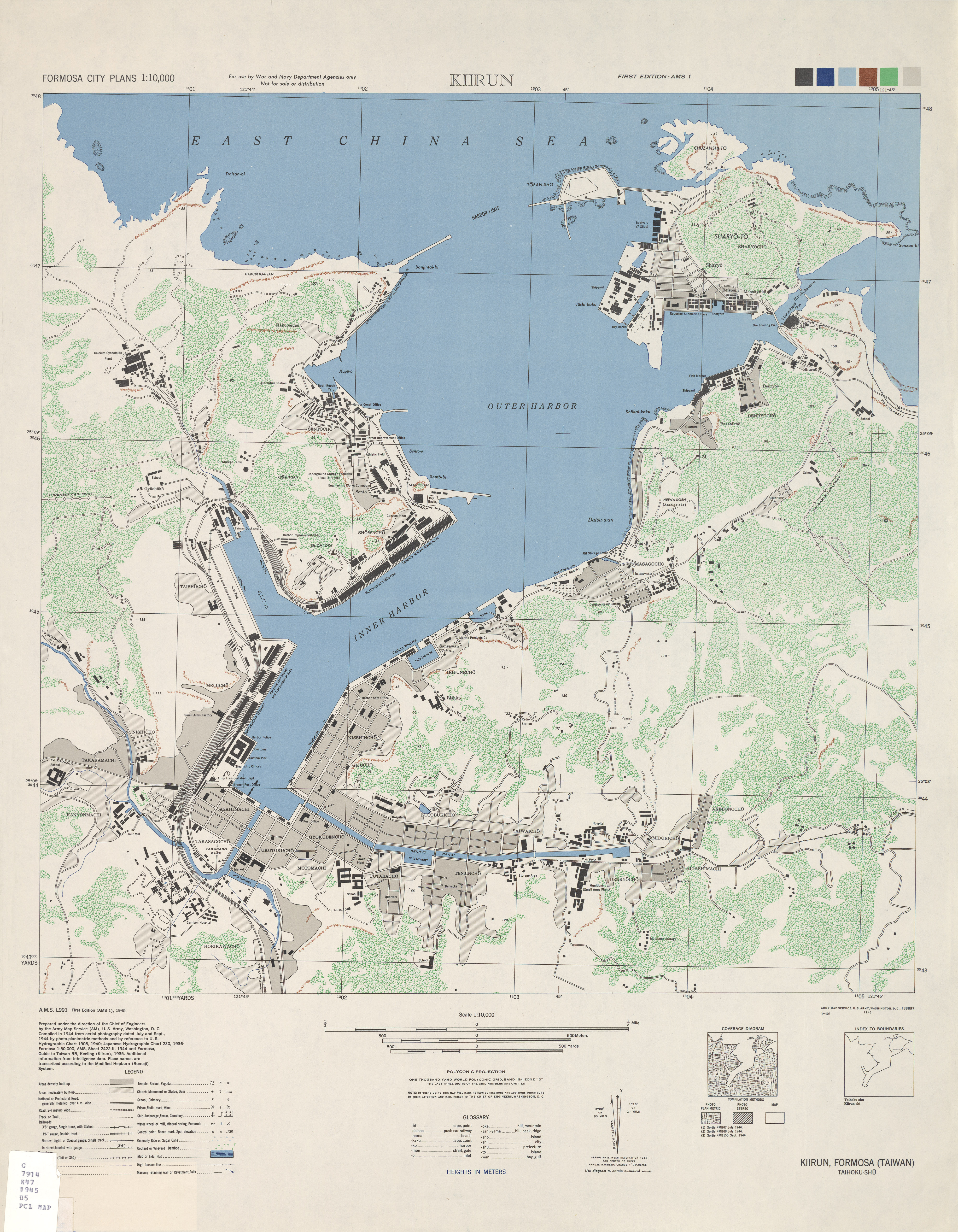
France's capture of the harbor in the autumn of 1884 drove the Qing defenders into the hills between Keelung and the Keelung River (see contemporary map here). Here they hastily built a second line of fortifications to frustrate any further French advance and provide forward bases from which to launch counterattacks. They also threw up trenches and protective works above the interior bank of the Keelung River to insure against a breach of the second line.

This network of fortifications left Keelung so well guarded that, when preparing to battle the armed resistance opposed to their takeover in 1895, Japanese military commanders chose to land their main force 30km to the south (at Gongliao [貢寮]) and approach the harbor from behind via a 2-day march over rugged mountain terrain. Even then, it took a fatal blunder by Chinese troops for the Japanese to storm Keelung's principal defenses without heavy casualties. Chinese records tell of a fierce battle fought in inclement weather along the slopes of Shiqiuling (獅球嶺) that caused heavy casualties on both sides. One version of events says that Cantonese soldiers guarding the battery mistook as Japanese the unfamiliar Chinese dialect spoken by an approaching Taiwanese relief force and opened fire. The Taiwanese, believing the Qing troops to have mutinied, fired back. The fighting decimated Shiqiuling's defenses. The Japanese took the fort the next morning and marched, almost unopposed, into Keelung.


Learning from experience, Japan reconfigured Keelung's defenses to handle potential threats from rival powers, including Russia, England, and (in the 1940s) the United States. Many of the Sino-French War era emplacements set next to Keelung Bay were abandoned and replaced by modern batteries set along strategic hilltops. New installations at Dawulun (大武崙), Baimiweng (白米甕), Shen Ao Keng (深澳坑), Gangziliao (槓子寮), and elsewhere afforded better defensive coverage and gave full play to the range and firepower of modern Western artillery.


- JM

2008-02-24

Let Your Fingers Do the Walking - Taiwan Tourism in the Yellow Pages (中華黃頁英文版建議老外如何遊台灣)


(see bottom of entry for links to higher resolution tourism page images)

It started at the height of last summer with an introduction to Chunghwa Yellow Pages (中華國際黃頁股份有限公司), the newly independent former subsidiary of the national telephone service provider Chunghwa Telecom (中華電信). Would I be interested to help proofread 70 or so pages of English slated for publication in the coming year's national Yellow Pages?

"Sure." Work was to follow a format applied from previous years and material would mostly be mined from earlier editions and updated as needed by YP staff.

An abiding interest in travel around the island led me to peruse the tourism sections of previous years' editions, which, not unexpectedly, were built of borrowings from various websites and information from the national Tourism Bureau. YP encouraged my being creative, particularly with this section, and invited me to pick and choose from information gathered over the years to make these pages more practical and attractive; important – they felt - to expanding Yellow Pages readership and, ultimately, increasing advertising revenues.

While guidebooks, travelogues and magazines dedicated to the ins and outs of Taiwan travel have inundated bookstore and convenience store shelves in recent years, their usefulness to non-Taiwanese readers is limited, as they are almost exclusively presented in Chinese and naturally tailored to local travel habits and preferences (e.g., easy access and good photo ops; night market reviews; souvenir shopping suggestions). While government budgets are being spent and things are improving in terms of foreign language information on Taiwan, presentations are still too often limited to summary translations of Chinese language material that are heavy on florid adjectives and trivia, and short on practical details and useful background information. Exploring Taiwan beyond Taipei City and a few major tourist attractions still requires a fair dose of "derring-do" and a steadfast confidence that good Samaritans along the way will point you in the right direction (which, in hospitable Taiwan, is still very much the case).

I pitched an idea to develop the tourism section of the upcoming edition of the English Yellow Pages from scratch... suggesting 4 general areas in Taiwan that I would visit and introduce from a perspective more familiar to overseas visitors. I wanted to create something that could be used as a practical travel guide by non-Chinese speaking travelers and which would set travelers up nicely for a 2 to 3 day stay in each area introduced.

The proposal included research, design, content development, photography, page layout ... the whole works. It went through, an agreement was signed and I set to work - with a deadline for 22 finished pages set 1-1/2 months away.

The following (click on a small images to open higher resolution scans) are a few pages from the 2007/2008 Taiwan English Yellow Pages, hot off the press (well, as of late January). It was a great experience. I learned much and had a chance to test out a different approach to introducing visitors and expatriates to Taiwan "off the beaten path".

(click to view higher resolution images)

(click to view higher resolution images)

(click to view higher resolution images)


JM

2008-02-12

Cycling Taiwan (台灣腳踏車遊)


Growing up in the Michigan countryside, I learned early the freedoms afforded by a bicycle. I explored fairly fully the dirt roads in and around Metamora and occasionally struck out for longer hauls to Oxford. I thought it a pretty impressive accomplishment when I finished my first round trip to Lapeer - some 25 miles away. My gold ten-speed offered mobility, exercise and a way to get to and from summertime lawn mowing jobs.


Once at university, however, shorter distances and the prospect of worrying over the safety and health of a bike chained to a grill outside East Quad relegated cycling to an occasional activity done more to renew the feel of high school than to commute around Ann Arbor (although I did make it out to Ypsilanti once). When during our senior year one of my best friends shared her plans to spend the upcoming summer on a month-long cross-country bike caravan (Seattle to Michigan), I could only wonder at the challenges ahead.

A move to Taiwan in the early 1990s made prospects of cycling even more remote. While Taipei, mercifully, is now ringed with bicycle paths and cyclists have increasingly taken to braving city streets (where motorists have grudgingly begun to accept their right-of-way), all this came, regrettably, after my time. Our move to Keel
ung was prompted, in fair part, by the prospect of more space, green views and roads to bike.

As before, I took to exploring the immediate vicinity and first saw much of Keelung and the Northeast Coast's green interior from a bicycle seat. While the region has some of the island's most rugged coastal terrain, roads tend to follow valleys as much as possible, making for treks that rarely exceed a "moderate" level of difficulty (of course, there are also plenty of hills to navigate if one so desires).

If I have set an example for others by pedaling out on the weekends, many have since outdone me. A few of our friends now often commute by bike from their homes near Keelung to jobs in Taipei (about an hour+, over heavily trafficked roads) and several families in our church meet nearly "religiously" on Saturday mornings to cycle over increasingly challenging courses in Keelung and Taipei County. What's more, with our children now increasingly able and willing to participate, cycling is being embraced as not only a family activity, but as a way to face and beat new challenges, develop a rapport with the outdoors and give (and receive) support as part of a team.


Over the past two months, my daughter and I have had the pleasure to join in two challenging cycling activities. The first, described briefly in a previous post, was organized by the Chinese Christian Relief Association (中華基督救助協會) as an event to draw attention and donations to the CCRA's ongoing work with disadvantaged families and after-school tutoring for children with special needs. Nineteen teams of two set out early on December 14th from the Eluanbi (Erluanbi, 鵝鸞鼻) Lighthouse at Taiwan's southernmost point – hopeful that they would achieve Taiwan's northernmost point at Fuguijiao (富貴角), 700 km away and 9 days later. The challenge of the trip was enhanced by our riding tandem (2-person) bicycles and the participation of primarily non-seasoned cyclists (including us). Nearly half the teams had pre-teens on the second seat. Quite a few in the group were over 60. The youngest was five.

The route was planned so as to pass through major towns, where brief PR events, often attended by local officials, helped publicize the CCRA cause. We stuck largely to main county roads, which took us through Taiwan's industrial heartland. Actually, getting away from industry along the western coast is difficult without either navigating the awkward web of roadways that skirt the Taiwan Strait or heading into the Central Mountain foothills. Both present challenges best left for another cycling trip.


The weather cooperated to a surprising degree, with sunshine following us nearly all the way to Taoyuan County. Tara's initial nonchalance about the challenges ahead (she'd heard that kids could ride in the chase car [小蜜蜂] if their legs gave out) turned into impressive determination. She biked behind me the entire 700 km, growing in self-confidence and experience.


We reached Fuguijiao on the North Coast late on December 22nd after a day under overcast, occasionally drizzly skies. Tara proudly remarked that she wouldn't mind continuing on down the East Coast – mostly because she wanted to continue traveling with this tremendous group


and partly because she felt that more biking beat, hands down, the prospect of returning to school in another two days. Thirty-eight individuals had come together as strangers and were to part as friends. The support team fielded by CCRA handled the difficult logistics necessary over the entire trip, which included escorts from county police, event organization, overnight arrangements, rest stop and lunch arrangements and the handling of myriad details of which we could only appreciate the results. Their dedication, given to help ensure the CCRA can continue in its main mission, testifies most strongly to the value of CCRA work in Taiwan.


Soon after returning home, we were invited by the abovementioned group of weekend bikers to join in a planned cycling trip in February from Keelung to Taitung (Taidong, 台東), down the East Coast. We agreed, but with consternation over the weather – which had (and has) been atrocious (rainy and cold) for the past month across northern and eastern Taiwan. As our departure on February 1st drew near, the weather simply got worse.


It had not improved by the time we gathered in Guogang (過港 / 暖暖) outside of Keelung on Friday morning. Two families, including ours, opted for the warmth of the chase cars, in which we followed those (three families, including 5 kids!) who had elected to brave it out. We met up in Fulong (福隆) for lunch, after which the bikers followed the coast southward to finish up the 95 km scheduled for Day One at Wujie (五結鄉), south of I-Lan City, and we surrendered to an afternoon at the hot springs in Jiaosi (礁溪).


The rains petered out, and everyone, including Tara and I, made the remainder of the 5-day journey by bike (although we all opted out [per plan] of biking the 100km-long Suhua Highway (蘇花公路) – known for its dramatic scenery, sharp curves and careening gravel trucks).


The East Coast from Hualien City down through Taitung is a wonderful ride. We took the relatively level Rift Valley (mostly down County Route 193 [193縣道]), passing mile after mile of newly planted rice paddies before heading into the Coastal Mountains south of Yuli (玉里鎮). After a steady, but manageable, uphill climb of 5 or so kilometers, we passed through a newly completed 2km tunnel on Yuchang Road (玉長公路) that opened onto Taitung County and marked the start of a brisk downhill ride to the Pacific shoreline. We ended our journey at Sansiantai (Sanxiantai, 三仙台) north of Taitung City, piled the bikes into our two vans and headed northward the next morning toward home.

Unsurprisingly, in light of eastern Taiwan's unpredictable winter weather, the day we drove back was the first to see sunny blue skies. We stopped off at several places, including the coastal scenic area at Shihtiping (石梯坪) and a special bed & breakfast place (Houhu, 後湖水月) that serves up great views of the coast and wonderful morning coffee – thanks Wendell (!).


Tara and I look forward to continued biking adventures. Our two experiences this winter have taught us that distance biking around the island is both doable and fun. Passersby were always ready with a thumbs-up and a smile. We saw many other biking groups on the road as well - most traveling without a support vehicle and their gear and travel essentials strapped across the back tire and under the seat. No matter where you find yourself in Taiwan, chances are you aren't excessively far from civilization – particularly if your definition of such covers 7-11s, ... which truly are everywhere.


- JM

2007-12-25

A Warm & Caring Christmas to All

-
-
-
-
-
-
-
We wish you warm holiday wishes,
a Christmas infused with love
and forgiveness and a New Year
in which to help neighbors in need
and invest in helping mankind
live once again within the earth's
generous, but limited, means.

- JM


2007-12-08

Riding with the CCRA (1919愛走動,協力車活動)


From 12/14, My daughter and I will participate in a week-and-a-half CCRA (中華基督救助協會) charity tandem bike venture starting at the southern tip of Taiwan (Kenting 墾丁 / Eluanbi 鵝鸞鼻), following the western (Taiwan Strait) coast and ending 10 days later after reaching Taiwan's northernmost point at Fuguijiao (富貴角). Nearly twenty bikes and forty people are participating and, hopefully, the ride will enjoy weather that is just a bit overcast and cool but dry. Is this asking too much? I hope not!


I'm looking forward to spending ten days on the road with Tara! ... A real father-daughter adventure.


Basic information on the event is posted (in Chinese) at: http://www.ccra.org.tw/active/content.asp?ID=46

2007-12-03

Spoils of a Distant Conflict - Taiwan and the First Sino-Japanese War (甲午戰爭)


It is unfortunate that so many of the "highlights" of Taiwan history seem centered on conflict – some big (like the 17th century ousting of the Dutch VOC and the Sino-French War) and some small (such as the myriad turf battles fought between different Chinese clans, between immigrant Chinese and indigenous Malayo-Polynesians, and between local malcontents and provincial authorities). This has led many in Taiwan to view the island's historical record as something best forgotten. However, recalling the decades (and occasional centuries) of relative peace between conflicts and the disparate influences (both positive and negative) that Taiwan's numerous occupiers and long-term residents have had on local culture and development leaves much room to recast the story of Taiwan to recognize its place on Greater China's eastern frontier while accepting and appreciating a cultural tapestry that includes more than a dozen important Malayo-Polynesian groups, Europeans, Japanese and Chinese from nearly every corner of China.


Physical separation from China – a two-day, dangerous journey by junk from Xiamen (廈門, Amoy, the main embarkation point for Taiwan on the Chinese Mainland) – ensured that Taiwan remained unknown to most Chinese and beyond any semblance of Chinese control until almost the 18th century. Taiwan's two centuries as part of China (1683 to 1895), were chaperoned, in the main, by unexceptional sub-provincial officials from Fujian who tried to profit as best they could from their assignment in the "sticks" while being either studiously avoided or taken advantage of by their subjects, ... who were also busy working to turn a profit from their adopted island.


The real threat of Taiwan being pared off by Japan, the U.S. or a European power helped finally turn Beijing's attention to island affairs in the 1870s. The military beefed up coastal defenses, installed and maintained strategic pathways (including Batongguan, 八通關越嶺道), and raised lighthouses to bolster China's claim to active sovereignty and give potential occupiers pause for thought before committing troops. Attention to the island spiked again after the Sino-French War (1883-85), when the island was granted provincial status (Taiwan had previously been governed as part of Fujian Province). The capital was moved from sunny Tainan to soggy Taipei and one of the Empire's first commercial rail lines was installed to link the deepwater port of Keelung to Taipei (Banka, 艋舺) and Hsinchu.


In the end, it was all a case of too little, too late. The island's status as a relatively recent acquisition, its physical separation from the Chinese Mainland, its proximity to Japan and the disintegration of central authority across much of China made Taiwan too tempting a prize in the aftermath of a war fought far to the north.

The First Sino-Japanese War (1894-1895)

In the closing years of the 19th century, Northeast Asia's crumbling status quo pushed Korea, ancient vassal and ally of China, to the center of regional rivalries. Japan wanted control of the strategically positioned peninsula and saw in either a collapse or rejuvenation of China the inevitable transformation of Korea into a forward base for unfriendly powers. On the one hand, China's collapse could very well consign the peninsula to Russia, Japan's main strategic rival in Northeast Asia. On the other, China's rejuvenation would surely reinforce the prejudices of Confucian Korea against Japan - a nation "slavishly" adopting alien Western values. Japan initiated hostilities to pull the kingdom, preemptively, into its political orbit.

Albeit brief and decisively one-sided, the First Sino-Japanese War (甲午戰爭) holds claim to several "firsts". It was the first modern conflict between Asian powers and the first time the latest in maritime weaponry – the ironclad battleship – had a central role in combat. It was also Japan's first test as an ascendant power in the Pacific.

The war represented a calamitous setback to China's efforts to limit to a handful of coastal districts foreign influence in her country. Ten years later, much of eastern China was open to trade and travel; Beijing had been sacked by an army of eight allied countries; and foreign powers had taken formal control of five new enclaves along China's seaboard as well as prime real estate in the northeast.

Positioned on the southern flank of the Ryukyu Islands (琉球, Loo-Choo Islands [see map here], which Japan had annexed less than two decades before), Taiwan was coveted by expansion-minded Japanese as both a protective buffer for the home islands and a projection of imperial ambitions in Asia. China, its imperial capital exposed and Northern Fleet at the bottom of the Yellow Sea, could offer little resistance to Japan's peace terms, which, among other demands, included the surrender of Taiwan and the Penghu (Pescadore) Islands. The Treaty of Shimonoseki was ratified on 8 May 1895, and China left Taiwan to its fate under Japanese occupation. The handover ceremony, originally scheduled to take place in Taipei, was actually convened in choppy waters off Bitoujiao (Punto San Diego) – Qing officials fearing reprisals from Taiwanese loyalists should the ceremony take place on land.

Largely unaware of the scale of their country's military defeat; sure of the difficulties Japan would have in occupying Taiwan; and hopeful that Japan's European rivals might step up to the island's defense, local Qing officials (to the apparent annoyance of the imperial court) and prominent Taiwanese made a hasty declaration of Taiwan independence -- 15 days after Treaty ratification and 6 days prior to the arrival of Japan's occupation force. Likely reflecting the sentiments of the island's ethnic Chinese majority, which had not previously contemplated separation from China, the president of the newly declared Republic of Formosa (台灣民主國), Tang Jingsong (唐景崧), professed the island's continuing loyalty to the Qing throne and subordinacy to China as a tributary state.

- JM