Showing posts with label 腳踏車. Show all posts

2009-06-02

Keelung to Taipei in 01:03 (騎省道台五線輕鬆地打通基隆及台北的界線)


I’ve long taken to cycling around Keelung as a primary - rather than alternative - mode of transportation. With the exception of winters, which do get unpleasantly damp and dreary, the city and its immediate periphery are not just cyclable, but compact and ‘visually interesting’ - prompting feelings that many more people, with two good legs and an agenda not callling for heavy shopping, should leave their car or scooter in the garage and venture out on bicycles.

Apart from exercise and convenience, cycling allows ‘ponder time’ – time to think about this and that, including ways of making the immediate neighborhood, Taiwan and the world greener and more sustainable.

I’ve been cautioned by numerous friends and strangers of the dangers of Taiwan roadways - plagued as they are by fast drivers more concerned with getting to point B than with the occasional cyclist (or pedestrian) in the way. To this, I might add precariously double-parked vehicles, road debris, potholes, steep curbs and (particularly when caught at a stoplight behind a row of motorcycles) bad air. Most roads here simply are not ‘cyclable’ in the ideal sense of the word. Many a conversation has simply ended on that note. It would be wonderful if - by some adroit stroke of policy or, perhaps, by gasoline prices inching their way beyond the reach of casual motorists … or by more people simply electing to bike - more drivers began commuting hither and thither on bicycles.


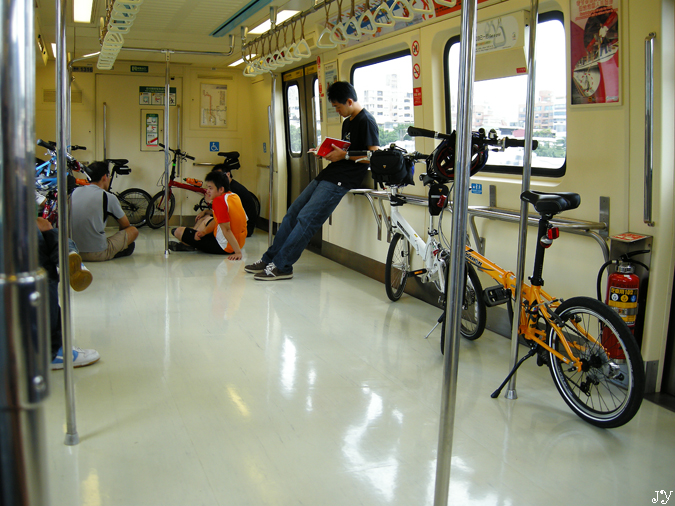
As seen to some degree already in neighboring Taipei City, the simple act of installing recreational cycling trails around the urban periphery has spawned an entire new generation of cyclists happy to don quirky Styrofoam helmets and lug odd-looking 'collapsibles' onto the MRT. As more people propel themselves with pedal power, we naturally grow more aware of the potential and the need to make urban environments more ‘user friendly’. Pressures for real commuter bike trails, safer roads, better air quality, better regulations, better urban planning … all come gradually into play and help foster (hopefully) a better environment across the board. Keelung City, still visibly deficient in both imagination and self-confidence, remains, physically and spiritually, so far removed from any of this … but one must first dream.


Sign warns of malevolent local auto with some deep-seated issues about
motorcycles and those who ride them. Fortunately, it wasn't home when I passed by.

Xizhi - south of the river

I’ve circled the island by bike slightly more than twice now, and continue to enjoy distance cycling. One section I’d never previously biked, however, was that between Keelung and Taipei. Separated by just 25+ kilometers, getting between these two cities is pretty straightforward - simply requiring the braving of Provincial Route 5 (新台五路). However, I’d always pinned hopes on a gentler, nicer bicycle route opening along the Keelung River (基隆河), running, somehow, from around Nuan Nuan (暖暖) into downtown Taipei.


Now, with those river hugging trails still patchy, but at least three-quarters in place, I set out a couple of weeks ago to see how far I could get. I quickly found, however, that the river’s north-south sweeps add significant kilometers to little advantage. Turns out that the new and growing Keelung River Trail is much more suited to local recreators than to those looking to link to places further afield.

Once again, thoughts returned to Provincial Route 5. PR-5 follows roughly the route taken by the main roadway that connected Taipei to Keelung Port and northeastern Taiwan before completion of Taiwan’s first highway (中山高速公路) in 1978. Apart from a modest 1km incline to the road’s highest point in Xizhi (汐止市), PR-5 is a relatively smooth ride both to and from Taipei (this incline can be more or less avoided by following a detour which slices through the container yard district into Xizhi City - which will add an extra half km to your route).


For the serious ‘commuter’ biker, PR-5 is the only way to go, as it leads from downtown Keelung to downtown Taipei (at Zhongxiao and Nanjing East Roads) directly through the string of towns in between. What’s more, keeping a regular pace, it took me just 63 minutes to arrive at the center of Taipei (corner of Zhongxiao East & Dunhua North roads) from my Keelung apartment - just enough time to listen to REM’s In Time through to the beginning of 'Everybody Hurts' on the way there and Abba Gold through to the finish of ‘Does Your Mother Know’ on the way back. Driving into Taipei, if you include time spent hunting for parking, can sometimes add up to as much.

Over the past several weeks I’ve made three bicycle commutes into Taipei along PR-5 at different times of the day. Traffic is moderate and relatively non-threatening outside of rush hour, during which time the road gums up with motorcycles and cars wanting to avoid the NT$40 highway toll.


I’ve not seen other cycling ‘commuters’ taking this route, but hope there are at least a few regulars out there keeping this route warm. A properly demarcated bike lane along most of PR-5 would be an inexpensive and excellent first step forward toward encouraging commuters to cycle rather than drive between Keelung and Taipei and - perhaps more realistically to begin with - points in between.

- JM

2009-05-04

New NE Coast Walkway / Bike Path Opens (新開的外木山到翡翠灣的自行車步道)


After a sabbatical of nearly a year, I'm back with more articles and thoughts on life along Taiwan's Northeast Coast and travels around the beautiful island of Taiwan.


I took the afternoon this past Sunday to collect thoughts; ponder the meaning of life, the universe and Everything and get some exercise during a spell of balmy spring weather. I frequently cycle the Keelung (基隆市) to Feicui (Jade or Green) Bay [翡翠灣] route, and my mettle has been oft tested ... and cycling direction occasionally diverted ... by cognizance of the challenges presented by the formidable hills straddling the Keelung City / Taipei County border - just ahead of the fishing town of Wanli (萬里鎮).


This time, cycling through Dawulun (大武崙) and then huffing up Provincial Route 2, which follows a coastal ridge overlooking Dawulun Fishing Port (大武崙漁港) & Waimushan Beach (外木山海水浴場), I was pleasantly surprised to find myself paralleling a new wood planked walkway installed to connect Dawulun Fishing Port (the walkway actually starts from the nearby pink [and now defunct] outdoor swimming complex-cum-seafood restaurant) to Wanli's fishing harbor, next to the wide sand beach along Feicui Bay. The walkway skirts the coast, avoiding hills and attendant steep grades. Very pleasant - with panoramic views of the rocky shoreline and Keelung Islet in the distance.


While this new walkway and bike path extends just 2.5km, when packaged together with the readily biked coastal roadways further westward and the 2-year old bike path that connects Waimushan Beach almost into Keelung City's busy downtown, cyclers can now navigate relatively easily a pleasantly undulating coastal route from downtown Keelung out as far as Yeliu (野柳), Jinshan (金山) and beyond.


This section of the coast is simply gorgeous, passing several sand beaches and majestic sandstone formations (including the 'Frozen Beach' outcropping just before Yeliu), as well as several 'human interest' points including pre-fab 'UFO' vacation bungalows (great pics here) just east of the Howard Plaza Green Bay Resort; northern Taiwan's main jump-point for hang gliding; trails leading up to the Japanese-era Dawulun Fort (大武崙砲臺) and several shallow, easy-to-access snorkeling / diving areas.

Departing from Keelung City, a cycling trip to Jinshan can be done in under 1.5 hours (one-way) taking advantage of the new coastal walkway. Plan on much more time, however, to enjoy all the out-of-the-way attractions this 25km stretch of coastline has to offer. If planning to walk, I recommend driving Route 2 to Waimushan Beach (map location here), where there is usually adequate parking space, and exploring the area from there.

Just a note ... To check out the deteriorating (albeit quite photogenically) Reagan-era fiberglass-reinforced 'UFO' vacation bungalows without paying for Howard Plaza Resort admission - cycle or walk through the narrow alley immediately to the left of the 7-11 on Route 2. The alley takes a few short jogs before opening onto the bungalow district and adjacent sand beach.


A Google Map rough-and-dirty guide to the approximate route from Keelung City out to Jinshan can be viewed by opening the link here.

- JM

2008-05-21

Leave Your Bike at Home (捷安特自行車租賃計畫)

Flexible Multi-Day Cycle Rental Program Offered by Giant

Giant Bicycles Corporation (捷安特), Taiwan's largest bicycle designer, builder and retailer, offers a highly attractive rental program (自行車租賃) to encourage more Taiwanese to take multi-day cycling trips across the island. The program lets you choose from two mid-range (NT$20,000 / US$650) bicycles [Great Journey 1 and CRX-2] and comes with a saddle bag and support kit that includes basic cycle accoutrements (air pump, tool kit, flashlight, lock, etc.).


The program allows rentals and returns at any of Giant's 30 some wholly-owned distributors (contact details for around 15 of them are posted in Chinese here). For our most recent cycling journey from Kaohsiung to Taitung, we rented bikes from Giant's Zuoying (Tsoying) outlet (捷安特左營店, tel: 07-348-0975), a 10 minute walk from the Zuoying High Speed Rail (HSR) station, and returned them at Giant's Taitung City outlet (捷安特台東店, tel: 08-934-7416).


The rental program is exceptionally cost effective, with rentals billed at NT$1,000 (US$35) total for the first three days and NT$200 (US$7) for each day thereafter. While bikes seem to be kept in good condition, make sure to give them a thorough once over before setting out. You probably will also want to consider packing a spare inner tube and/or tire repair kit as well.


The bicycle rental program is surprisingly under-advertised. Prior to our trip in March, I did a Chinese language search of the Internet and came up empty on any rental program details. The Giant website (also in Chinese) is quiet on the rental program as well ... the company apparently treating it as somewhat of a stealth operation. Giant may be concerned about over-subscriptions and thus prefers word of mouth promotion.


Program rules ask that you book reservations through your pick-up location (Giant outlet) at least one week in advance. English will likely prove too challenging for most of the store attendants taking phone-in reservations, so suggest that non-Chinese speakers book by e-mail. A partial listing of outlets with e-mail links follows:

Giant Taipei Hsinchuang (Sinjhuang / Xinzhuang)台北新莊店
Giant Bali (Shihsanhang) 十三行站
Giant Taipei Banqiao (Banciao) 台北板橋店
Giant Taipei Nanjing (Nanking East Road) 台北南京店
Giant Hsinchu Jiedeng 新竹捷登店
Giant Taichung City Hall 台中市政店
Giant Taichung Nantun 南屯店
Giant Taichung Beitun 太原站
Giant Fengyuan Circle 豐原圓環店
Giant Tainan City 台南店
Giant Kaohsiung Zuoying (HSR Station) 左營店
Giant Kaohsiung Qijin (Cijin) 旗津站
Giant Kaohsiung Ersheng 高雄二聖店
Giant Pingdong City (Pingtung) 屏東店
Giant Taidong City (Taitung) 台東店
Giant Hualien Liyutan 鯉魚潭站
Giant Hualien Qixingtan (Cisingtan) 七星潭站
Giant Yilan Zhongshan (Jhongshan) 宜蘭中山店


- JM

2008-05-15

Taiwan's Southern Cape (恆春半島)

Shipwrecks and Headhunters


Taiwan's extreme southeastern coast, still one of the most remote and lightly populated corners of this island, served as backdrop for a series of shipwreck dramas during the mid-1800s that made far off Formosa the talk of the Great Powers and got pundits in the United States, Japan and elsewhere talking about either buying Taiwan from China's Manchu rulers or simply taking it by force.


Truculent weather, hidden coral reefs and hostile inhabitants irritated shippers and made Taiwan's dangerous shores an occasional cause célèbre for those out to make the world safe for civilization and Free Trade. In the two decades between 1850 and 1870 alone, some 150 Western vessels met their end in Taiwan waters.


In 1867, after crashing onto coral, crew and passengers of the U.S. ship Rover straggled onto a rocky stretch of southeastern shoreline only to lose their lives to indigenous Malayo-Polynesians (still headhunters at the time). A similar fate met the survivors of other shipwrecks, including 54 hands aboard a Ryukyuan fishing / trading boat that foundered along the same stretch of coast in 1871. Their capture and death at the hands of Paiwan (Botan, 排灣) warriors near the current town of Hsuhai (旭海村) gave Meiji Japan an excuse to dispatch an expeditionary force to the island in 1874, which lingered more than six months, killed several dozen of the elusive Paiwan and lost over 500 of their own number - mostly to tropical disease. This half year sojourn, known today as the "Mudan Incident" (牡丹社事件), is often cited (in hindsight) as the first move in a Japanese plot to wrest Taiwan from China - an effort that culminated two decades later in the 1895 Treaty of Shimonoseki (馬關條約).

I'd read about the wrecks and heard about the rough landscape that greeted survivors ... now I had a chance to see it firsthand. ... read on.

The Challenge

Cycling around Taiwan, either in sections or the entire 1,000+km circuit, has come into vogue over the past several years. The initiative has complex roots, but seems driven at its core by a growing desire among the population here to ponder their identity as Taiwan islanders (rather than immigrant or transplanted Mainland Chinese) and subsequent curiosity on the part of those with time (i.e., students) or money (mostly white collar professionals) to finally explore their homeland in a challenging but (now) socially acceptable way - straddling a top-of-the-line touring bike and wearing the latest in sweat-free fashion. The screening in 2006 of the semi-documentary film Island Etude (練習曲:單車環島日記) [link to YouTube trailer here, and great song from the film here] and promotional support from the island's globally competitive bicycle manufacturers gave the movement its 'wings' ... and it is now difficult to travel anywhere off the highways and not see long-distance cyclers on their way somewhere. This is a fad that will hopefully strike deep roots and continue growing. Taiwan has much to offer in the way of scenic beauty and friendly faces - enjoyed all the more from the seat of a bicycle.


A good friend and professor of law at one of Taiwan's leading universities is already well into a plan, put together with half a dozen former classmates (now all middle-aged professionals, of course), to circle Taiwan together by bike. They are doing the circuit in sections so as to minimize disruption to work schedules, with each section a 3~4 day chunk of time - usually astride a weekend.


The next section awaiting them was the southern cape, a "U" route beginning just north of Kaohsiung (高雄市) and ending in Taitung City (Taidong, 台東市), some 250 kilometers away [see route map here]. I asked to join when discussions turned to biking all the way down to Hengchun (恆春) before crossing over to the Pacific Coast rather than via the easier (but highly trafficked) Southern Loop (南回公路, Route 9). Added enticement was the prospect of a challenging but pleasant few hours of shouldering bikes across a several kilometer section of remote and roadless southeastern shoreline - the selfsame coast described above. Little in the way of information on this area is available (not even in Chinese ... it is quite remote). Blogs by several Taiwanese cycling teams gave an idea of what we might expect in pictures and limited descriptions (follow links here 1 & 2).

Taiwan's far south is an amazing place to cycle due to its remoteness, tropical beauty and relaxed airs. We rented bikes from Giant at an outlet several blocks away from the southern terminus of the High Speed Rail (HSR, 高鐵) in Tsoying (Zuoying左營), a northern suburb of Kaohsiung City. The stretch of Provincial Route 17 south through Kaohsiung City and into northern Pingdong County traverses the badlands of Taiwan industrialization. Petrochemical factories in particular dominate the skyline and keep the area cloaked in a fine grey acidic haze. We mercifully left industry behind about 4 hours into our trip and began to enjoy the windy and exceptionally scenic Pingdong coast along Provincial Route 1 ... and then 26. Having pedaled out from Zuoying at around 10:30am (after arriving on the first HSR service of the day), we reached our Hengchun B&B after dark, about 8:00pm - inclusive of stops for lunch and a bit of sightseeing.


(click to open larger picture)

(click to open larger picture)

From Hengchun, we cut eastward the next morning on County Route 200 into rolling hills (that bear, I thought, some resemblance to south Texas) before veering southeastward on Route 200 "jia" (甲) toward the small village of Gangkou (港口村) on the Pacific. The road ended at Provincial Route 26, which we followed north and past a toll booth happy to collect NT$60 a head (the student rate) for permission to continue on to the absolute end of this section of Route 26 at Jialeshui (佳樂水 or 佳洛水) - some 2 kilometers further on.

A late start in the morning meant it was two o'clock by the time we had polished off lunch and commenced carrying our bikes. We weren't initially aware that the entire coastline ahead (some 12 kilometers) was devoid of all but perhaps 200 meters' worth of bike-friendly footpaths and that we would be pushing and carrying our bikes for a full 7-1/2 hours to come. The day was one of those "once in a lifetime" adventures. As we prodded our cycles across the rocky shore covered in sandstone boulders of assorted sizes, I could easily picture how disappointing this stretch of Taiwan must have appeared to soggy shipwreck survivors a century ago. The ribbon of rocky coast, averaging some 30 meters wide, ends abruptly against steep slopes covered in impassable tropical grasses and screw pine (林投, Pandanus odoratissimus ... see pictures here).

With the exception of a few fishermen encountered not far from the trail entrance, we had the entire coast to ourselves that afternoon. At each promontory we expected / hoped to hook up with a dirt path that would take us off the beach and eventually to the road we needed to take to our Hsuhai B&B reserved for the evening ... It was not to be. Night closed in soon after seeing the first twinkling lights of civilization - still a hard 3~4 kilometer walk away. We pressed on with flashlights after nightfall and emerged at around 9:30 in the tiny fishing village of Nanren (南仁村). Exhausted, we were kindly taken in by an 80 year-old fisherman and his wife, plied with sports drink and pot noodle, and offered a room in which to bunk for the night. We accepted graciously, and slept exceptionally soundly on beds of plywood paneling covered with bamboo mats.


Our third day out took us north along the perimeter of the island's largest sand dune (at Jiupeng Bay, 九鵬灣) toward the town of Hsuhai (旭海村, where those Ryukyuan fisherman were waylaid in 1871). Until recently, the entire area between Nanren and Hsuhai was an ROC military preserve. Much of the interior, home to Taiwan's main missile testing facility, remains so. From Hsuhai, we cycled inland along very scenic Route 199 - from sea level to about 400m (around the town of Shouka [壽卡]). Once we connected with the Southern Loop (Route 9), it was an exhilarating coast all the way back to the Pacific. We still had a ways to go before finally making Taitung County's Jinlun Village (太麻里金崙村) and the Eastsun Resort & Spa (東太陽溫泉會館) - our inn for the night.

The fourth day was comparatively anticlimactic, although still liberally sprinkled with gorgeous Pacific Coast scenery and still a challenge with plenty of inclines to huff up along Provincial Route 9. In Taitung City, we returned our rented bikes to the city's main Giant outlet, ate lunch and headed by car back down Provincial Route 9 toward Kaohsiung and an HSR ride homeward. We just made the last High Speed Rail out of Zuoying (about 10:40pm) and got into Taipei in time to ride the last intercity bus back to Keelung. The adventure had remained so down to the last minute ...


(click to open larger picture)


4-Day Cycling Itinerary (see map here for details)

Day 1: Zuoying (高雄市左營區 a northern suburb of Kaohsiung City) - Hengchun (屏東縣恆春鎮, close to Kenting 墾丁)

Day 2: Hengchun - Gangkou (港口村) - Jialeshui (佳樂水) - Chufengbi (出風鼻) - Nanren (南仁村)

Day 3: Nanren - Jiupeng Bay (Jiupengwan, 九鵬灣) - Hsuhai (Xuhai,旭海村) - Shouka (壽卡) - Daren (達仁) - Jinlun (太麻里金崙村)

Day 4: Jinlun - Taitung City (台東市)


- JM