I’ve long taken to cycling around Keelung as a primary - rather than alternative - mode of transportation. With the exception of winters, which do get unpleasantly damp and dreary, the city and its immediate periphery are not just cyclable, but compact and ‘visually interesting’ - prompting feelings that many more people, with two good legs and an agenda not callling for heavy shopping, should leave their car or scooter in the garage and venture out on bicycles.
Apart from exercise and convenience, cycling allows ‘ponder time’ – time to think about this and that, including ways of making the immediate neighborhood, Taiwan and the world greener and more sustainable.
I’ve been cautioned by numerous friends and strangers of the dangers of Taiwan roadways - plagued as they are by fast drivers more concerned with getting to point B than with the occasional cyclist (or pedestrian) in the way. To this, I might add precariously double-parked vehicles, road debris, potholes, steep curbs and (particularly when caught at a stoplight behind a row of motorcycles) bad air. Most roads here simply are not ‘cyclable’ in the ideal sense of the word. Many a conversation has simply ended on that note. It would be wonderful if - by some adroit stroke of policy or, perhaps, by gasoline prices inching their way beyond the reach of casual motorists … or by more people simply electing to bike - more drivers began commuting hither and thither on bicycles.
Apart from exercise and convenience, cycling allows ‘ponder time’ – time to think about this and that, including ways of making the immediate neighborhood, Taiwan and the world greener and more sustainable.
I’ve been cautioned by numerous friends and strangers of the dangers of Taiwan roadways - plagued as they are by fast drivers more concerned with getting to point B than with the occasional cyclist (or pedestrian) in the way. To this, I might add precariously double-parked vehicles, road debris, potholes, steep curbs and (particularly when caught at a stoplight behind a row of motorcycles) bad air. Most roads here simply are not ‘cyclable’ in the ideal sense of the word. Many a conversation has simply ended on that note. It would be wonderful if - by some adroit stroke of policy or, perhaps, by gasoline prices inching their way beyond the reach of casual motorists … or by more people simply electing to bike - more drivers began commuting hither and thither on bicycles.


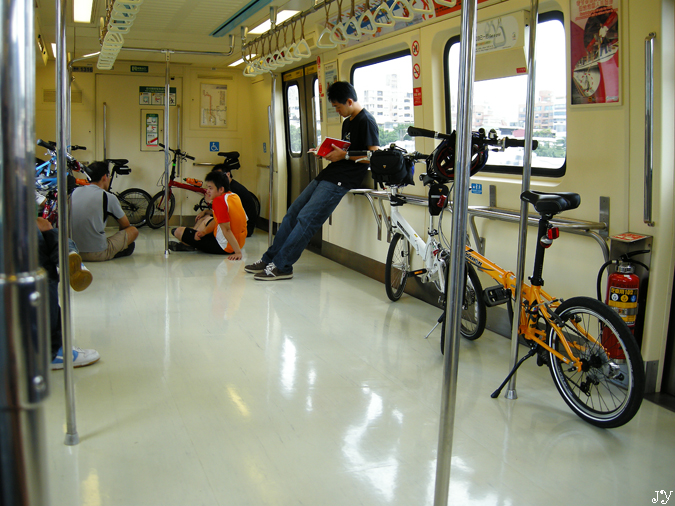
As seen to some degree already in neighboring Taipei City, the simple act of installing recreational cycling trails around the urban periphery has spawned an entire new generation of cyclists happy to don quirky Styrofoam helmets and lug odd-looking 'collapsibles' onto the MRT. As more people propel themselves with pedal power, we naturally grow more aware of the potential and the need to make urban environments more ‘user friendly’. Pressures for real commuter bike trails, safer roads, better air quality, better regulations, better urban planning … all come gradually into play and help foster (hopefully) a better environment across the board. Keelung City, still visibly deficient in both imagination and self-confidence, remains, physically and spiritually, so far removed from any of this … but one must first dream.

Sign warns of malevolent local auto with some deep-seated issues about
motorcycles and those who ride them. Fortunately, it wasn't home when I passed by.

Xizhi - south of the river
I’ve circled the island by bike slightly more than twice now, and continue to enjoy distance cycling. One section I’d never previously biked, however, was that between Keelung and Taipei. Separated by just 25+ kilometers, getting between these two cities is pretty straightforward - simply requiring the braving of Provincial Route 5 (新台五路). However, I’d always pinned hopes on a gentler, nicer bicycle route opening along the Keelung River (基隆河), running, somehow, from around Nuan Nuan (暖暖) into downtown Taipei.

Now, with those river hugging trails still patchy, but at least three-quarters in place, I set out a couple of weeks ago to see how far I could get. I quickly found, however, that the river’s north-south sweeps add significant kilometers to little advantage. Turns out that the new and growing Keelung River Trail is much more suited to local recreators than to those looking to link to places further afield.

Once again, thoughts returned to Provincial Route 5. PR-5 follows roughly the route taken by the main roadway that connected Taipei to Keelung Port and northeastern Taiwan before completion of Taiwan’s first highway (中山高速公路) in 1978. Apart from a modest 1km incline to the road’s highest point in Xizhi (汐止市), PR-5 is a relatively smooth ride both to and from Taipei (this incline can be more or less avoided by following a detour which slices through the container yard district into Xizhi City - which will add an extra half km to your route).


 For the serious ‘commuter’ biker, PR-5 is the only way to go, as it leads from downtown Keelung to downtown Taipei (at Zhongxiao and Nanjing East Roads) directly through the string of towns in between. What’s more, keeping a regular pace, it took me just 63 minutes to arrive at the center of Taipei (corner of Zhongxiao East & Dunhua North roads) from my Keelung apartment - just enough time to listen to REM’s In Time through to the beginning of 'Everybody Hurts' on the way there and Abba Gold through to the finish of ‘Does Your Mother Know’ on the way back. Driving into Taipei, if you include time spent hunting for parking, can sometimes add up to as much.
Over the past several weeks I’ve made three bicycle commutes into Taipei along PR-5 at different times of the day. Traffic is moderate and relatively non-threatening outside of rush hour, during which time the road gums up with motorcycles and cars wanting to avoid the NT$40 highway toll.

I’ve not seen other cycling ‘commuters’ taking this route, but hope there are at least a few regulars out there keeping this route warm. A properly demarcated bike lane along most of PR-5 would be an inexpensive and excellent first step forward toward encouraging commuters to cycle rather than drive between Keelung and Taipei and - perhaps more realistically to begin with - points in between.
- JM


 In the closing years of the 19th century, Northeast Asia's crumbling status quo pushed Korea, ancient vassal and ally of China, to the center of regional rivalries. Japan wanted control of the strategically positioned peninsula and saw in either a collapse or rejuvenation of China the inevitable transformation of Korea into a forward base for unfriendly powers. On the one hand, China's collapse could very well consign the peninsula to Russia, Japan's main strategic rival in Northeast Asia. On the other, China's rejuvenation would surely reinforce the prejudices of Confucian Korea against Japan - a nation "slavishly" adopting alien Western values. Japan initiated hostilities to pull the kingdom, preemptively, into its political orbit.