2007-10-29

Historic Lighthouse Location Map

Here is a map, using Davidson's 1903 map of Taiwan as a base, showing the location of various historic lighthouses around Taiwan and dates built. Note that the current lighthouse at Bitoujiao (鼻頭角) is a relatively modern (1960s) reconstruction ... but the scenery in and around is still gorgeous and worth the 40 minute walk from the main road! (double-click to open larger image)


- JM


2007-10-27

Lighthouses in Taiwan (台灣的燈塔)

Lighthouses are set along magical promontories at lands' end, ... places to enjoy a bit of solitude, breathe deep and clear out some of the cobwebs.

Beware: Island Ahead - Taiwan's Lighthouses

When junks (highly maneuverable, shallow-draft ships) still carried most of East Asia's sea commerce, there was little need for permanent navigational beacons. Pirates and difficult handling in rough water tended to restrict travel to daylight hours and good weather. When needed, bonfires could be lit on hilltops to guide wayward vessels home after nightfall.

However, from the early 19th century onward, a fast growing intercontinental trade carried aboard purpose-built clippers redefined maritime shipping needs. A permanent network of lighthouses was necessary to ensure the safety of these new ships, which were often at sea for days or weeks at a time. To the modest beacons already marking the entrances of early trade outposts like Manila and Batavia (Jakarta), western business interests gradually added permanent lighthouses in Hawaii (1840), Singapore (1851), Sakhalin (1860), China (1865), and Japan (1866). By the turn of the 20th century, lighthouses watched over all major trading ports as well as many of the region's navigational hazards.

The "frontier" flavor of the pre-1895 Formosa trade meant that Taiwan's earliest lighthouses were installed to warn ships away from coastal danger rather than guide them to safe anchorage. Shipwrecks along Taiwan's southernmost peninsula, which saw survivors lose their lives to indigenous tribesmen or get roughed up by Chinese, inflamed international public opinion and spurred policymakers in Japan and the United States during the mid-19th century to toy with thoughts of occupying Taiwan's eastern seaboard (based on the argument that failure to bring eastern Taiwan to heel placed the region beyond Qing sovereignty and, in the logic of 19th century Great Powers, into a power vacuum). In the end, belated Qing attention to the island, a Civil War in the United States, and alarm amongst European imperialists (who viewed such an occupation as the beginning of a free-for-all grab for territory that could quickly engulf all of China) conspired to keep Taiwan Chinese, for the moment.

The Qing built and garrisoned the island's first lighthouse on the hazardous southern cape at Eluanbi (Erluanbi, 鵝鸞鼻) in 1882. The northeast coast got its first lighthouse in 1896 high above Bitoujiao's (鼻頭角) jagged shoreline, some 50km southeast of Keelung. The Japanese built Keelung's first lighthouse in 1899 along the harbor's northwestern entrance to support early modernization efforts.


In addition to those at Bitoujiao and Keelung, lighthouses of historical and scenic interest in northern Taiwan include Sandiaojiao (Punto San Diego - 三貂角, built in 1931) and Fuguijiao (Eerste Hoeck - 富貴角 built in 1896), as well as an ascetic beacon on the scenically interesting Yeliu Peninsula (Punto Diablo - 野柳), built in 1967. Agincourt is northern Taiwan's most visually impressive and least accessible lighthouse. Raised in 1906, the Victorian structure rises 26 meters above Pengjia (Pengchiayu, 彭佳嶼), a windswept volcanic islet of 114 hectares situated 56km northeast of Keelung.
-JM

2007-10-24

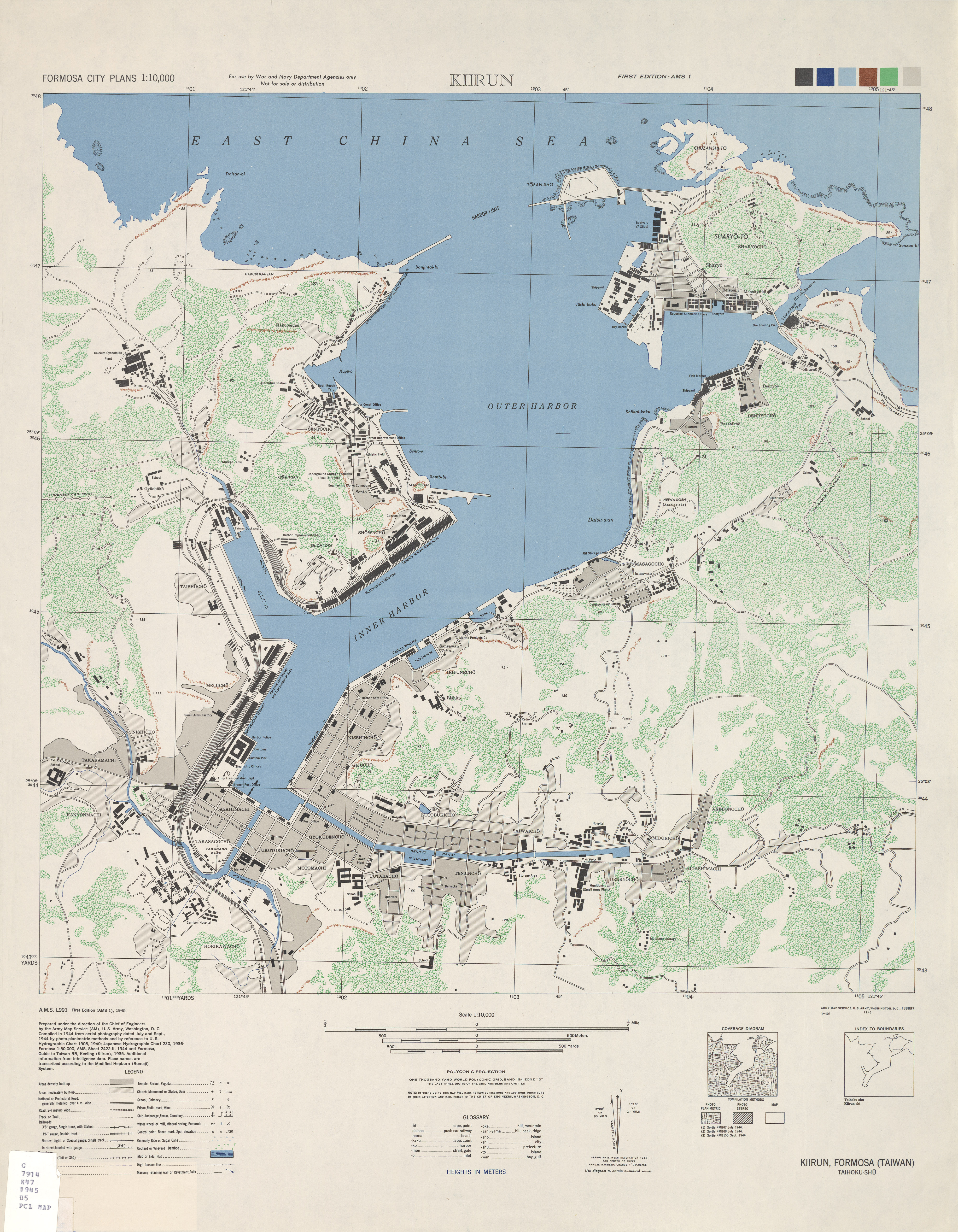
An Introduction to Keelung City (基隆市簡史)

The "importance" of Keelung, as with Taiwan itself, is much more accident of history than expression of intrinsic character. Nevertheless, the human drama that has played out here over the past few centuries give it a charm, which, after scratching the surface, has held my interest and piqued my curiosity to learn more.


Downtown Keelung occupies an incredibly small patch of level real estate, centerpieced by a large commercial harbor. Over the past half century, the city has grown up ... and out ..., leaving the cramped downtown districts stuck with sad-looking multi-story buildings fronting mostly two-lane streets that, while likely suiting the town 50 years ago, now only add to reasons to visit the city only on weekdays, when things are relatively calm and most people are elsewhere.

From the harbor, moving a kilometer or so in most any direction takes you out of the city and into green hills. The whole Northeast Coast, with Keelung somewhere in the middle, rides atop the eastern edge of the Eurasian Plate. Unlike further south, where the entire plate has been pushed skyward (along Qingshui / Cingshuei Cliff [清水斷崖]), Eurasia seems to have ... well ... crumbled in northern Taiwan along numerous faults, which have since gone their own way to fashion today's complex topography of mild slopes and precipitous dropoffs. Some of these mini-faults drew magma to the surface, which further complicated the terrain with volcanic protrusions like the Yangming Mountains, Keelung & Turtle Islets (基隆嶼 / 龜山島), and the mineral-rich hills around Jinguashih (金瓜石).

For me, this is what makes Keelung - beyond city center - a cool place to hike, explore and enjoy.


I wrote the following some time ago to tie together for myself some of the important historical threads woven into this corner of Taiwan.

Reluctant Crossroads
Keelung's Incommodious Introduction to Modernity
當中西相遇 - 基隆簡史


Keelung (基隆市) is Taiwan's second largest port and fifth largest city, with narrow, congested streets, busy seafood restaurants, and a night market (Miaokou, 廟口) that draws uncomfortably large numbers of visitors on weekends. International trade drives this bustling town of 375 thousand and commerce pumps briskly through its veins.


This was not always the case. When imperial Chinese officials, at the head of a sprawling and largely self-sufficient continental empire, were forced to open Keelung to foreign trade in 1860 (under the Treaty of Tientsin [天津條約], which ended the Second Opium War), they would have been hard pressed to describe the town beyond its position on a map.

In 1860, Keelung comprised settlements on and around Keelung Bay, with a combined population of probably no more than five thousand. Fishermen here sold their catch to traders, who would haul goods by foot and sampan to markets on the agricultural plain some 30km inland. Residents grew rice, vegetables, and tea in the valleys and on the alluvial plain. Coal deposits, found throughout the Keelung area and of great interest to foreign powers, were widely speculated about, but, as of yet, worked only on a small scale.


Indeed, until 1891, when the opening of China's first commercial railway provided a more or less stable link between the port and the flourishing inland outpost of Banka (Manka / Taipei), Keelung residents lived largely isolated from the rest of Taiwan behind a curtain of abrupt hills and narrow river valleys. Even at the dawn of the 20th century, footpaths through these hills were still the chief means of getting to and from the town. They made an overland commute to anywhere else a serious undertaking.

Keelung has always looked to the sea for its livelihood and for greater purpose. Japanese and Chinese adventurers and pirates, perhaps some of the island's first residents from the Asian mainland, established long-term encampments along the Keelung narrows (on and around Peace Island [和平島]) as early as the 15th century. The Spanish, then Dutch, built permanent fortifications here during the 17th century as way stations for lucrative trade with Japan and China, and (for the Spanish) for the galleon trade between Asia and the Americas.

Formal Chinese rule in Taiwan first came in 1661 when General Koxinga (a.k.a. Zheng Chenggong, 鄭成功), champion of the vanquished Ming dynasty (1368-1644), regrouped his forces on the island following successive defeats in China against the empire's new Manchu (Qing) rulers. Koxinga besieged the ill-prepared forces of the Dutch East India Company on Taiwan and accepted the surrender of all Dutch outposts on the island the following year. From Keelung and other Taiwan harbors, Koxinga and his successors harassed shipping up and down the China coast until 1683 when, weakened by internal squabbles and the resolve of its adversary, Koxinga's Taiwan was absorbed into the ascendant Qing dynasty. Used to the Manchurian plains and highly suspicious of the open sea, the Qing largely ignored China's water links with the outside and limited coastal trade. Keelung faded into obscurity for nearly two centuries.


The 1860 Treaty of Tientsin ignited a commercial revival in Keelung that hummed along for two decades. Trans-Pacific steamers hauling cargo from China to the Americas called regularly at the port to take on fuel; coal mining grew into a major industry (In 1881, Keelung produced about 60,000 tons of mostly bituminous coal); and the town became a hub for a flourishing Chinese domestic trade across the Straits.

Occupation by France during the Sino-French War (1883-1885) destroyed most of Keelung and warned Qing officials that success as a steamship depot had made the town an all too tempting target for acquisitive colonial powers. Their fears were not unfounded. China's loss of Hong Kong Island to Britain in 1842 was followed in succession by the loss of other strategic ports including Shanghai (上海), Weihai (威海, Weihaiwei - to Britain), Qingdao (青島, Kiautschou - to Germany), Zhanjiang (湛江, Kouang-Tchéou-Wan - to France), and Lushun (旅順, Port Arthur - to Russia ... and then Japan). Further improvements to the harbor were suspended and the town went to seed. Even the landmark 1891 rail link to Taipei was described as rickety and unreliable only four years after its completion. Western steamships no longer called and the last of Keelung's foreign merchants left to pursue more profitable investments.

Keelung's fate took a final, abrupt turn when Japan took control in 1895. The Japanese, recent converts to imperialism who lacked the natural resources of other Great Powers, were eager to exploit Taiwan's agricultural and mineral wealth. Officials gave top priority to constructing modern commercial and transportation infrastructures geared to channel goods to and from Japan. The harbor was dredged and expanded, new docks were built, and Keelung was turned into a modern colonial city - soon overtaking Tamsui as Taiwan's busiest port. Trade leapt by a factor of thirty in 5 years - from $225 thousand in 1896 to nearly $7 million in 1901. Trade through Keelung included large volumes of tea, camphor, China grass (for straw hats and rope), Japanese manufactured goods, and opium.


Decimated by US bombers during the Second World War, harbor facilities were gradually rebuilt and enlarged after Taiwan was handed over to Nationalist Chinese control in 1945. While Kaohsiung has since eclipsed the city as Taiwan's most important commercial port, Keelung remains today a critical portal for the island's export-driven economy. Beyond Keelung's hopelessly congested city center, quiet alleys and fern shaded hills stand silent guard over important reminders, in numerous fortifications and historic trails, of the city's interesting and often turbulent past.

- JM

2007-08-18

The Sino-French War / 中法戰爭 (1883 - 1885)


I've an ingrained enthusiasm both for the outdoors and for history.

When we moved from Taipei to the outskirts of Keelung in 1999, among the practical enticements included green hills to hike (Taipei, by contrast, is largely flat and paved) and a vague notion that the port had been occupied at some point by France.

Over the past eight years, I have trekked across much of the Northeast Coast and its hinterland (as well as elsewhere). Not only are remnants of the Sino-French War (中法 or 清法戰爭) still clearly evident along the hilltops and ridges that ring the city, the area is also peppered with many other vestiges of history and previous economic activity. Such continue to make this area an interesting place to live and explore.


As a prelude to long-planned (well, in my head at least) blog-type entries on hiking, historical sites, flora, etc., I plan to post to this site some topical introductions (tagged "background") to various aspects of my city on the sea. Content is my own, drawn from various English and Chinese sources, and can be used elsewhere as long as the source is cited.

A Quickie Guide to the Sino-French War

A decade of hostility between France and China over influence in Annam (modern Vietnam) climaxed in the Sino-French War. French authority in the area had grown steadily since France established the colony of Cochin China (in the Saigon Delta) in 1862. Legionnaires captured Hanoi in 1882 and the king of Annam acknowledged French suzerainty in 1883.

Facing imminent loss of a vassal and southern buffer against belligerent colonial powers, China dispatched troops to Annam to help indigenous Vietnamese and Black Flag irregulars fight the French. (In one interesting historical note, the Black Flag society (黑旗隊) formed in 1866 in south China to challenge Qing authority during the Taiping Rebellion [see Wikipedia article here]. The Emperor later granted Black Flag members amnesty in exchange for pledges of loyalty. In the 1870s and 1880s, the group was engaged by anti-French members of the Annamese nobility to help fight French influence in their country.)


Now at war (albeit unofficially) with China, France broadened the conflict beyond Vietnam to the China coast in hopes a series of decisive victories there would force a Qing capitulation. French warships shelled Mawei (馬尾, near Fuzhou) and Tamsui (淡水) and troops stormed Keelung and Magong (馬公, in the Penghu Islands).

However, France largely failed to achieve its strategic objectives. Qing troops consistently outnumbered and, in many important battles, outmaneuvered their adversary. In northern Vietnam, France endured significant setbacks and, in Taiwan, held Keelung harbor and several adjacent valleys only at a high price in blood.

China nonetheless did not press its advantages in the field and the Emperor's military advisers were consumed with a fear that France's navy, sailing unopposed in the East China Sea, would move north and land troops to threaten the capital at Beijing. The Treaty of Tientsin, signed in June 1885, ended hostilities. China acknowledged French control over Vietnam and France evacuated its remaining soldiers from Chinese territory ...


Keelung was a ten-month nightmare for French troops. Terrible weather, malaria, meager support from the high command, pesky British and American opportunists and an unexpectedly real Chinese resistance kept the French bottled up inside the first row of hills that separated the harbor from north Taiwan's interior (e.g., the Keelung River and Taipei Basin beyond). There was never a realistic prospect that France could have extended its occupation to Taipei (Banka) or elsewhere. The Qing government took very seriously France's attack on Taiwan, and the Chinese repulsed solidly a French attack on Tamsui and arrayed over 10,000 Mainland and Taiwanese soldiers in the hills surrounding Keelung to keep the 2,000 or so French Legionnaires and Bat d'Af soldiers from moving any further inland.

For the "honor" of France and the Legion, several months before abandoning Keelung for the relatively more pleasant Pescadore (Penghu) Islands, just over a thousand French soldiers made a final desperate push to take the heights above Keelung. Several days of horrific hand-to-hand fighting along ridgelines to the east of the harbor ended in France capturing "Fort Bambou", the highest crest overlooking the harbor, and sending most of the Qing army across the Keelung River, where defensive lines were reestablished.


Chinese military resistance to France in Taiwan was a resounding success, won largely by overwhelming manpower and a home field advantage. The French occupation was a strategic failure. France was never able to use the harbor as a supply depot (France's navy still used Jinmen and other islands for coastal activities), and hoped-for coal supplies lay beyond the occupied harbor area.

However, while China won the battle (for Taiwan), they lost the war. Irresolution at the upper levels of Qing officialdom and concurrent challenges to Qing sovereignty elsewhere convinced Chinese leaders to disregard successes at Keelung and Annam and sue for a quick peace, largely on France's terms.

For both the French and Chinese, hostilities in Taiwan represented an extemporized, ad hoc affair. Although wooden structures built by both sides have long since disappeared, dirt trenches, gun emplacements, and cleared areas for barracks and command posts remain intact to a surprisingly large extent. With preserving island history high in importance for most Taiwanese (tongue firmly in cheek), such remnants have since become good spots to grow bamboo or have simply gone back to nature. The government has made no effort to designate or restore Sino-French War sites, which all in all may be for the best ... until the construction industry figures out how to plant high rises along hilltops.

2007-08-14

Opening Shot / 第一炮

Please bear with me as I take a first few tentative steps onto the Internet.

I am an American, a native of Michigan, who has, since childhood, been drawn, transfixed, perhaps, to cultures very different from my own. It was most likely simply the contrasts presented by ancient Egypt, India and other cultures that tickled a deep curiosity. In relatively rural Michigan, a long way from either seacoast and comfortable in its Midwestern ways, the sheer distance of the outside world simply added to the allure.

I came upon the "Mysterious East" through a variety of routes, one of the most oft related being philately. True to form, I'd always left stamps garnished with pretty butterflies, bright colors and Marilyn Monroe in the box in favor of mono-colored, but much more interesting, selections from German Kiautschou, French Indochine
and strange places like Boheme et Moravie, Manchukuo and Tannu Tuva. The latter fascinated me in particular, but information was scarce and my attentions drifted eastward toward China, the nation to which Tannu Tuva had been appended on and off since the Yuan (Mongol) Dynasty. China in the early 1980s was at a crossroads between the train wreck that was the Cultural Revolution and the reworking of relationships with former adversaries in the West. Marilyn Monroe and bright colors had yet to make their impact felt on China's sober landscape, but the door was opening on a mono-colored world that had been off limits to much of the outside for decades.

Sure for years that I would study Chinese in Beijing, ... I arrived in 1986 as a college junior in Taipei, Taiwan … a one-way ticket (used) from Tokyo and admissions letter from the Taiwan Normal University Mandarin Training Center firmly in hand (two boxes of clothes and "stuff" would arrive by sea another month later). Beijing - my University of Michigan language exchange partner confided - was a city still largely unsure of how to handle foreigners in its midst. He assured me that Taipei, his hometown, would be a much better place to study Chinese.

I stayed in Taipei (at the International House [國際學社] – a 1960s-era dormitory later sacrificed when a full square city block between Xinyi and Heping Roads was reclaimed as urban green space) for a year, during which full-time studies improved my Chinese tremendously. I met the girl of my dreams, came back for another year of study in 1989 and chose in 1993 to move to Taiwan for a few years after finishing graduate school to get some practical business experience in Asia. We planned on a 7-year stay and the clock is now nearing the 14-year mark. I hear that we are not the first to find Taiwan a difficult (more or less in the pleasant sense of the word) place to depart.

Over these 14 years, I've found a comfortable groove in "cultural bridging". "West" and "East" continue to be puzzled by one another, not so much by the big issues anymore, but by the myriad little things that can stymie, impede and even end a relationship. Standing at the interface between Greater China and "western culture", I've found a positive role to play in bringing very different perspectives closer together, resolving misunderstandings and presenting sometimes difficult realities in ways more likely to be accepted by the recipient. Thus, I see my varied professional roles at the American Institute in Taiwan (the U.S. representative office on the island), Andersen Consulting, Unisys and a cool little start-up company called Productivity Asia (now Pacific GeoPro) as sharing a common "cultural bridging" denominator.


Living today in the outskirts of Keelung, with fern-cloaked hills pleasantly interspersed between high rise condominium communities predictably faced in uninspired pink or white tile (what was that about mono-color?), I enjoy hiking and biking whenever possible. Scratch the drab surface of this port city along the Northeast Coast (about 25km from Taipei) and there is significant charm and beauty to be found. Keelung was a Treaty Port from the 1860s until almost the turn of the century; French Legionnaires and Bat D'Af soldiers occupied the harbor for nearly a year during the Sino-French War (1883~1885); it is home to the first transportation tunnel built in the Chinese Empire (in the late 1880s), through which China's first commercial railway passed (linking Keelung to Hsinchu); and it was ringed by modern artillery batteries in the first decade of the 20th century to fend off, of all things, a potential attack from Imperial Russia.

While I enjoy sharing findings with fellow foreign (i.e., non-Taiwanese) friends, I enjoy sharing such even more with Taiwanese – who are nearly always taken unawares by the history and natural beauty to be found not far from their apartment. There seems to remain a lamentable lack of appreciation here for what lies beyond the living room TV set or favorite department store haunt.

At the encouragement of good friends, I've set up this blog where some of my accumulated findings, thoughts and insights on this corner of Taiwan and Greater China can be organized and posted. With my enjoyment of the outdoors, I will look forward to finally putting into some organized fashion recommended hiking trails and historical pointers. I intend to keep political commentary down to a minimum, not so much out of tact, but out of relative disappointment at the deafening silence heard from both/all sides of the spectrum on the "bread and butter" issues (education, infrastructure, clean governance, etc.) certain to make or break Taiwan's viability as an economy and as a voice worth listening to in the region and beyond. Taiwan's future still remains in its own hands ... and, while so, politicians here should be even more tightly bound by duty and mutual honor to steer this island forward to the best possible future for all of its people.

I intend to make this a bilingual blog, and will draft Chinese translations (not word for word, mind you) at another site, probably on Lifespaces. For those of you who are bilingual as well, don't judge the Chinese text too harshly, as I won't have an editor to streamline the presentation. I just hope to share my information and experiences with two major online language communities.

Now, on to a personal plug ...

I am now a full time freelancer and SOHO type (having ended out a 7-year position in mid-June working for the USDA at the American Institute in Taiwan). I have significant experience providing market and cultural consulting; cross-cultural content development, design and layout services; and Chinese-to-English translation. Other tailored services to bridge East and West can be provided as well ... I will be glad to quote prices (reasonable), provide references and send along a colorful PowerPoint presentation of previous work experience and results to those interested.

Thus ends my first blog entry … jm.keelung@gmail.com